General Counseling
Beginning Fall 2026, 12 classes will have new names and numbers:
Current NVC Course → Updated NVC Course- ARTH 105 → ARTH C1100
- ARTH 106 → ARTH C1200
- CFS 120 → CDEV C1000
- ECON 100 → ECON C2002
- ECON 101 → ECON C2001
- ENGL 121 → ENGL C1002
- ENGL 123 → ENGL C1003
- HIST 120 → HIST C1001
- HIST 121 → HIST C1002
- MATH 120 → MATH C2210
- MATH 121 → MATH C2220
- SOCI 120 → SOCI C1000
Welcome to General Counseling
Prospective Students
A NVC Student Application is required for all Counseling Services.
We are honored you are here! Counselors are connecting with students by appointment. You can self-schedule counseling appointments online or connect with our front office for help with scheduling. Appointments are accessible in-person, video, and phone, we recommend you meet with a counselor twice a semester (or) as needed.
Services
- Graduation Application Clerance
- Educational Planning
- Transfer Planning
- Career Advising
- Personal Counseling

You may fulfill Step 4, for Priority registration by completing an Abbreviated Ed Plan Form. This is a one- or two-semester class plan. After you submit the form, it will be reviewed by the General Counseling Front Office, and Step 4 will be marked as complete.
Contact Us
- (707) 256-7220
- nvccounseling@napavalley.edu
- Office 1339
-
Monday - Thursday: 9am - 5pm
Friday: 9am - 12pm
👥Counselors are currently seeing students on appointment basis only.
🕗 Appointments can be scheduled up to one week in advance.
*Available Until Filled
Schedule an appointment
Counseling Front Office
-
Dr. Ryan Smith
Dean of Counseling Services and Student Success
-
Renee Coffin
Senior Administrative Assistant Counseling Division
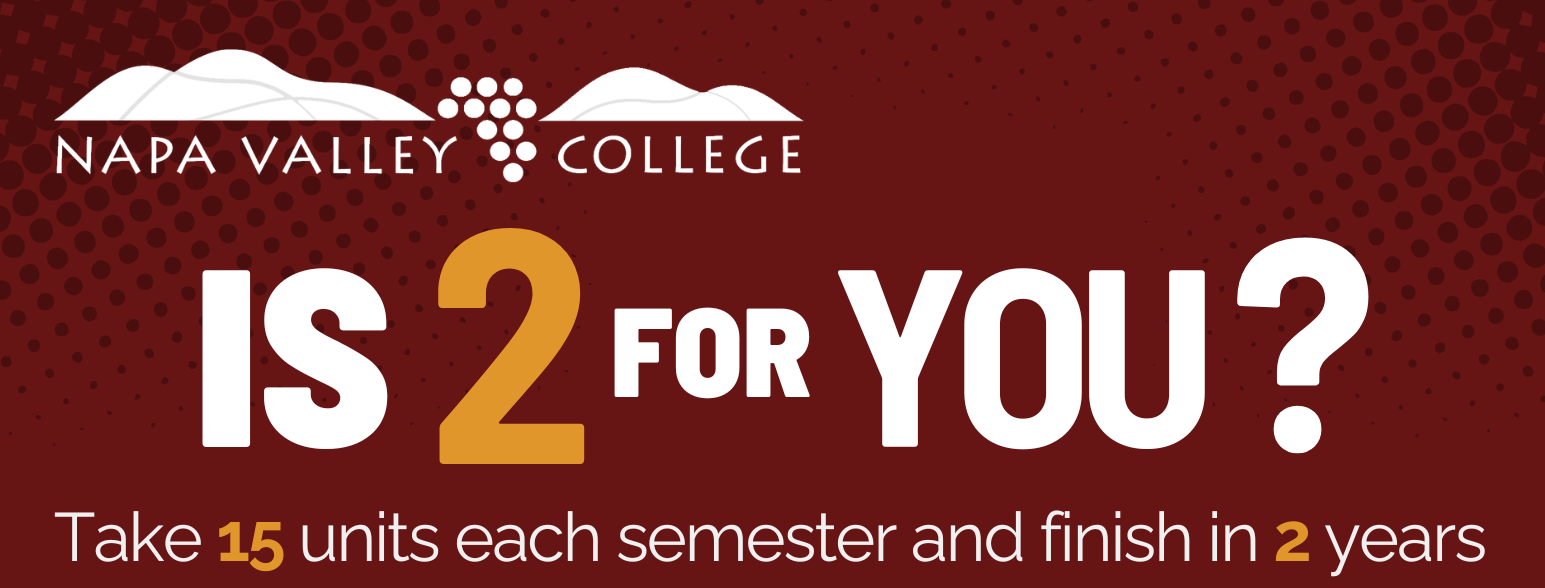
At Napa Valley College, many students want to earn an associate degree or transfer to a university as efficiently as possible. The “Is 2 for You” approach asks students to consider enrolling in 15 units per semester (30 units per year) to stay on track to complete their goals in about two years.
Every student’s situation is different. Some may take fewer units due to work or other responsibilities. A NVC counselor can help you create an education plan that fits your goals and schedule.
15 Units vs. 12 Units: What’s the Difference?
Academic Year
Year 1
Year 2
Year 3
15 Units / Semester
30 units completed
60 units completed
—
12 Units / Semester
24 units completed
48 units completed
60+ units completed
Quick takeaway:
15 units per semester helps many students finish in about two years, while 12 units
often extends the timeline.
Note: Some majors require more than 60 units, which may extend the timeline.
Benefits
Completing your degree or transfer preparation within two years has several benefits:
Stay on Track to Graduate
Taking 15 units per semester helps keep you on pace to complete an associate degree
in two years.

Finishing sooner can reduce:
- Additional semesters of tuition and fees
- Living expenses
- Delayed entry into the workforce
Reduce Student Debt
Graduating sooner may reduce the amount of student loan debt you accumulate.
Financial Support
Students enrolled in 15 units who have been awarded a Cal Grant B or C may be eligible
for up to $8,000 per academic year through the Student Success Completion Grant (SSCG),
contingent on available funding. SSCG funds are limited, and not all eligible students
will receive an award. Please check with the Financial Aid Office to confirm eligibility.
Visit the Financial Aid Office

Considerations
It’s also important to consider whether this pace works for your schedule and responsibilities.Time Commitment
A general guideline is that each college unit requires about 2–3 hours of homework
and studying outside of class per week.
For a 15-unit schedule (in a 16-week semester), this typically means:
- 17 hours in class per week
- 34–50 hours of studying and coursework outside of class
That’s 50–67 hours per week dedicated to school.

Maintaining a Strong GPA
While an associate degree requires a minimum 2.0 GPA, many students also plan to:
- Gain admission into a competitive university that will need a much higher GPA
- Apply to competitive majors or programs (such as nursing, business, engineering, etc.)
These academic goals often require higher GPAs, so it’s important to consider whether taking 15 units will allow you to earn the grades you need.

Working While Attending College
If you plan to work while taking 15 units, it’s generally recommended that students
work no more than 15–20 hours per week.
Working significantly more hours may increase the likelihood of:
- needing to drop classes
- feeling overwhelmed
- earning lower grades
Maintaining a Healthy Balance
Think about your full schedule:
- Work commitments
- Family responsibilities
- Personal obligations
- Time for rest and self-care
Will taking 15 units allow you to maintain a healthy balance and manage stress while staying successful in your classes?

Not sure what’s right for you?
Meeting with a counselor can help you explore your goals and build an education plan that fits your schedule and priorities.
Schedule an Appointment with a Counselor
✔ 15-Unit Readiness Scale
Use this quick self-check to see if a 15-unit schedule may work for you.
Give yourself 1 point for each statement that applies:
⬜ I can dedicate 50–67 hours per week to school and studying.
⬜ I plan to work less than 20 hours per week while attending college.
⬜ I have strong study habits and time management skills.
⬜ I am comfortable asking for help and using academic support services.
⬜ I want to finish my associate degree or transfer in about two years.
Your Score
4–5 points: May be ready for 15 Units - See a counselor!
2–3 points: Consider starting with 12–14 units
0–1 points: Build up gradually as you adjust to college

- Students will be able to succeed in college by accessing and utilizing college systems, services and resources.
- Napa Valley College Counselors are dedicated to student success. Our Counselors provide comprehensive academic support, while recognizing the individual needs of students within a diverse population.
- Counselors work with students in assessing, planning, and achieving their immediate and long-range goals, as well as assisting students in developing self-knowledge, self-esteem, and self-confidence to enhance student learning and success.
Student Affairs provides support and services that engage and empower students to achieve success.